Thursday, February 27, 2025

The Ultimate Guide to IPTV: Revolutionizing How We Watch TV

 The Ultimate Guide to IPTV: Revolutionizing How We Watch TV

The way we consume television has evolved dramatically over the past decade. Gone are the days of being tied to cable subscriptions or rigid broadcast schedules. Enter IPTV—Internet Protocol Television—a game-changer that’s redefining entertainment for millions worldwide. If you’re curious about what IPTV is, how it works, and why it’s worth considering, you’ve landed in the right place. Let’s dive into this ultimate guide that’s packed with everything you need to know about IPTV in 2025.

What is IPTV, Anyway?
At its core, IPTV stands for Internet Protocol Television. Unlike traditional cable or satellite TV, which relies on physical infrastructure to deliver content, IPTV streams television programming over the internet. Think of it like Netflix or YouTube, but with a focus on live TV channels, on-demand shows, and even exclusive content—all delivered through your internet connection.
What makes IPTV stand out is its flexibility. Whether you’re using a smart TV, smartphone, tablet, or even a dedicated IPTV box, you can access thousands of channels from anywhere with a decent internet speed. It’s no wonder IPTV is quickly becoming a go-to choice for cord-cutters and entertainment enthusiasts alike.

How Does IPTV Work?
You might be wondering: how does IPTV actually get TV into my living room? It’s simpler than it sounds. IPTV uses your internet connection to deliver video content via data packets. Here’s a quick breakdown of the process:
  1. Content Source: IPTV providers source live TV channels, movies, and shows from broadcasters or content creators.
  2. Streaming Servers: This content is then encoded and stored on powerful servers.
  3. Delivery: When you tune in, the IPTV service streams the data to your device in real-time over the internet.
  4. Your Device: With an app or IPTV player (like VLC or Kodi), you decode and watch the content seamlessly.
The beauty of IPTV lies in its use of IP (Internet Protocol)—the same technology that powers your emails and web browsing. This means no clunky satellite dishes or tangled cables—just pure, internet-driven entertainment.

Why IPTV is Taking Over in 2025
So why should you care about IPTV? Here are some compelling reasons it’s shaking up the TV industry:
  • Endless Options: From sports channels to international news, IPTV offers thousands of channels—often more than traditional cable—at a fraction of the cost.
  • On-Demand Viewing: Missed your favorite show? Most IPTV services include catch-up TV or a library of movies and series you can watch anytime.
  • Affordability: IPTV subscriptions are typically cheaper than cable packages, with many providers offering customizable plans.
  • Device Flexibility: Watch on your TV, phone, laptop, or even a Firestick—IPTV adapts to your lifestyle.
  • Global Access: Traveling abroad? With IPTV, you can still catch your hometown channels without geographic restrictions (depending on the provider).
In 2025, as internet speeds continue to climb and streaming quality improves (hello, 4K!), IPTV is only getting better. It’s no surprise that more people are ditching outdated cable setups for this modern alternative.

Types of IPTV Services
Not all IPTV services are created equal. Here’s a rundown of the main types you’ll encounter:
  1. Live IPTV: Think live sports, news, or events—like watching the Super Bowl as it happens.
  2. Video on Demand (VOD): Stream movies and TV shows whenever you want, similar to Netflix or Hulu.
  3. Time-Shifted TV: Rewatch shows that aired earlier, often with a 7-day catch-up window.
Some providers bundle all three into one package, giving you the ultimate entertainment trifecta. When choosing an IPTV service, consider what matters most to you—live sports, movies, or a bit of everything.

Is IPTV Legal?
This is the million-dollar question. The short answer: it depends. IPTV itself is a perfectly legal technology—big players like Hulu Live and YouTube TV use it. However, some unofficial IPTV providers offer pirated content or unlicensed channels at dirt-cheap prices, which can land you in murky legal waters.
To stay safe, stick to reputable, licensed IPTV services. Check reviews, ensure they have proper licensing, and avoid deals that seem too good to be true. Legit providers might cost a bit more, but they deliver reliable streams without the risk.

How to Get Started with IPTV
Ready to jump into the IPTV world? Here’s a step-by-step guide:
  1. Check Your Internet: You’ll need a stable connection—ideally 10 Mbps for HD or 25 Mbps for 4K streaming.
  2. Pick a Provider: Research trusted IPTV services with good reviews and channel lineups that suit your taste.
  3. Choose a Device: Smart TVs, Android boxes, or even your phone can run IPTV apps. Popular options include MAG boxes or Amazon Firesticks.
  4. Install an IPTV App: Download a compatible player like IPTV Smarters, TiviMate, or Perfect Player.
  5. Set It Up: Enter the provider’s M3U playlist link or Xtream Codes (provided upon subscription) into the app.
  6. Enjoy: Kick back and explore your new world of entertainment!
Pro tip: Many providers offer free trials, so test a few before committing.

The Future of IPTV
As we roll deeper into 2025, IPTV isn’t slowing down. With 5G expanding and smart home tech on the rise, expect even smoother streaming and more interactive features—like personalized channel recommendations or voice-controlled viewing. It’s an exciting time to be a TV fan.

Final Thoughts
IPTV is more than just a trend—it’s a revolution in how we watch TV. Affordable, flexible, and packed with options, it’s no wonder millions are making the switch. Whether you’re a sports nut, movie buff, or just tired of overpriced cable, IPTV has something for everyone.
So, what do you think? Ready to cut the cord and explore IPTV? Drop your thoughts below—I’d love to hear your take! And if you’ve already tried it, share your favorite service. Let’s keep the conversation going.
Happy streaming!
Tuesday, February 25, 2025

Best Wi-Fi and Postpaid Plans in 2025

 Best Wi-Fi and Postpaid Plans in 2025: Ultimate Guide to High-Speed Internet and OTT Benefits

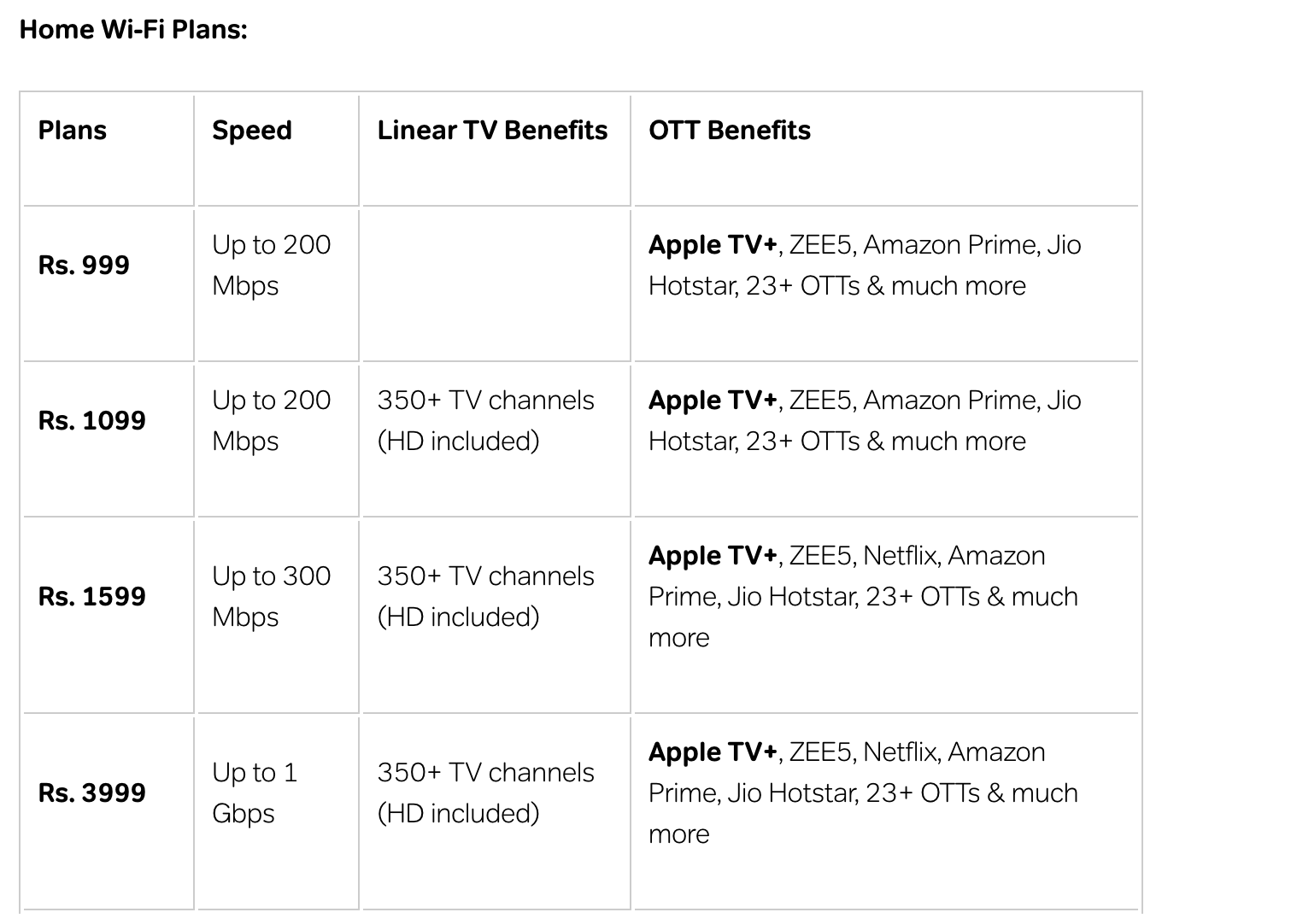
In today's digital era, choosing the right Wi-Fi and postpaid mobile plan can significantly enhance your online experience. Whether you’re a binge-watcher, a gaming enthusiast, or a professional working from home, selecting a plan that meets your needs is essential. Here’s a complete guide to the best Wi-Fi and postpaid plans for 2025, including high-speed internet, extensive OTT benefits, and value-for-money options.


Top Home Wi-Fi Plans with OTT Benefits

1. Rs. 999 Plan

  • Speed: Up to 200 Mbps
  • OTT Benefits: Apple TV+, ZEE5, Amazon Prime, Jio Hotstar, and 23+ OTTs
  • Best for: Budget users who want high-speed internet and premium OTT subscriptions.

2. Rs. 1099 Plan

  • Speed: Up to 200 Mbps
  • TV Benefits: 350+ TV channels (HD included)
  • OTT Benefits: Apple TV+, ZEE5, Amazon Prime, Jio Hotstar, and 23+ OTTs
  • Best for: Those looking for a balance between linear TV and OTT content.

3. Rs. 1599 Plan

  • Speed: Up to 300 Mbps
  • TV Benefits: 350+ TV channels (HD included)
  • OTT Benefits: Apple TV+, ZEE5, Netflix, Amazon Prime, Jio Hotstar, and 23+ OTTs
  • Best for: Streaming lovers who need both TV channels and OTT platforms.

4. Rs. 3999 Plan

  • Speed: Up to 1 Gbps
  • TV Benefits: 350+ TV channels (HD included)
  • OTT Benefits: Apple TV+, ZEE5, Netflix, Amazon Prime, Jio Hotstar, and 23+ OTTs
  • Best for: Power users who demand ultra-fast internet for 4K streaming and gaming.

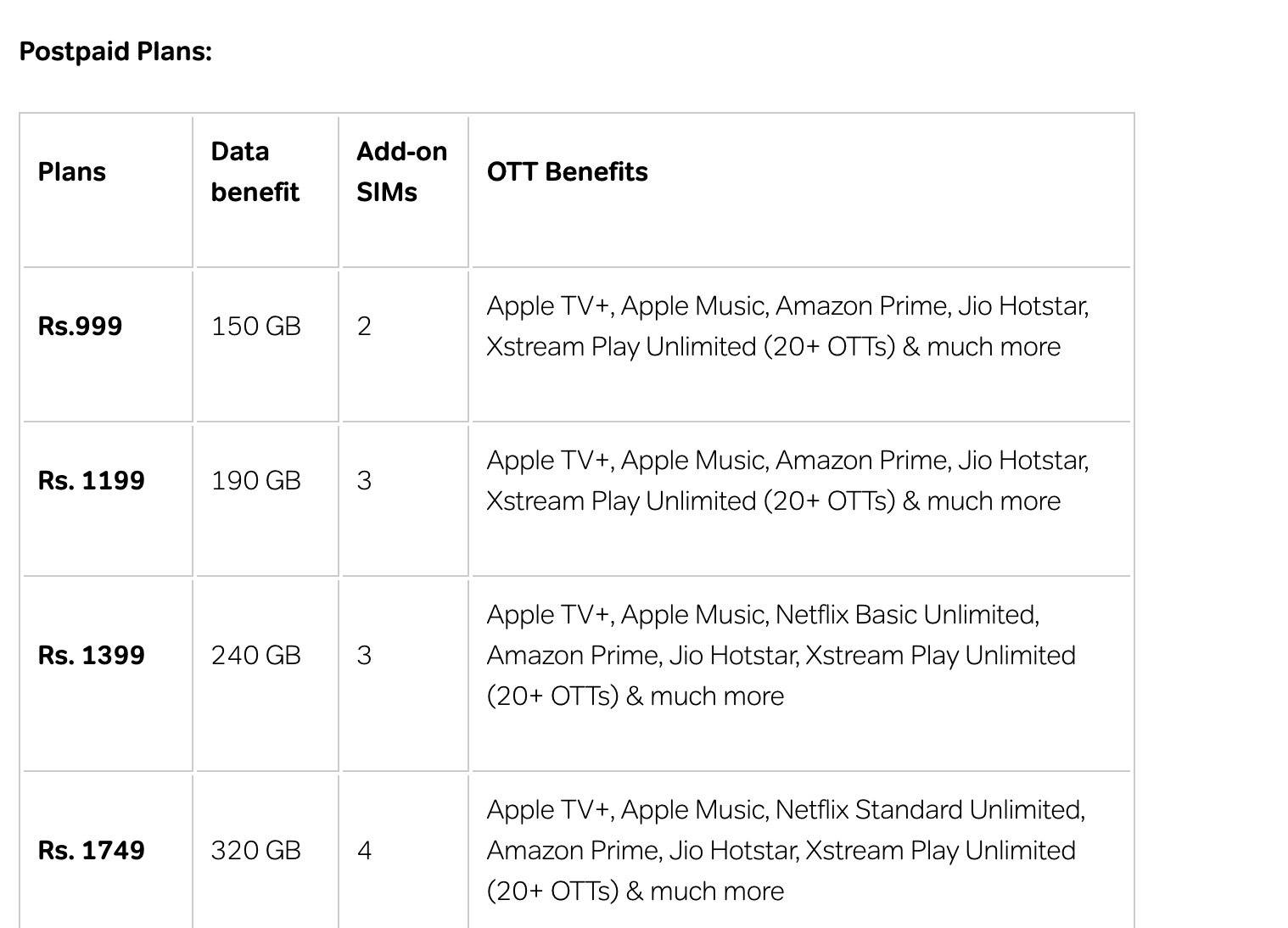
Best Postpaid Mobile Plans with Data and OTT Benefits

1. Rs. 999 Plan

  • Data Benefit: 150 GB
  • Add-on SIMs: 2
  • OTT Benefits: Apple TV+, Apple Music, Amazon Prime, Jio Hotstar, Xstream Play Unlimited (20+ OTTs)
  • Best for: Individual users with moderate data needs and access to premium entertainment.

2. Rs. 1199 Plan

  • Data Benefit: 190 GB
  • Add-on SIMs: 3
  • OTT Benefits: Apple TV+, Apple Music, Amazon Prime, Jio Hotstar, Xstream Play Unlimited (20+ OTTs)
  • Best for: Small families sharing data and OTT services.

3. Rs. 1399 Plan

  • Data Benefit: 240 GB
  • Add-on SIMs: 3
  • OTT Benefits: Apple TV+, Apple Music, Netflix Basic Unlimited, Amazon Prime, Jio Hotstar, Xstream Play Unlimited (20+ OTTs)
  • Best for: Users who want Netflix Basic included with their plan.

4. Rs. 1749 Plan

  • Data Benefit: 320 GB
  • Add-on SIMs: 4
  • OTT Benefits: Apple TV+, Apple Music, Netflix Standard Unlimited, Amazon Prime, Jio Hotstar, Xstream Play Unlimited (20+ OTTs)
  • Best for: Large families or groups sharing multiple SIMs with high data usage.

Why Choose These Plans?

  1. High-Speed Internet: Plans range from 200 Mbps to 1 Gbps, ensuring smooth browsing, gaming, and streaming.
  2. Comprehensive OTT Benefits: Access to top streaming platforms, including Netflix, Apple TV+, Amazon Prime, and more.
  3. Add-on SIMs for Families: Postpaid plans come with multiple SIMs, making them great for families and businesses.
  4. Value for Money: Competitive pricing with a combination of entertainment and high-speed internet.

Final Thoughts

Choosing the right Wi-Fi and postpaid plan depends on your usage patterns. If you need high-speed connectivity for streaming and gaming, the Rs. 3999 Wi-Fi plan is ideal. On the other hand, for mobile users who want premium OTT content with high data limits, the Rs. 1749 postpaid plan is an excellent choice.

Stay connected with the best plans and enjoy seamless entertainment in 2025!


#BestWiFiPlans #PostpaidPlans2025 #HighSpeedInternet #OTTSubscriptions #Netflix #AmazonPrime #AppleTV #JioHotstar #BudgetWiFiPlans #UnlimitedData

Friday, February 21, 2025

Microsoft’s Majorana 1: A Quantum Leap That’s Closer Than You Think

Microsoft’s Majorana 1: A Quantum Leap That’s Closer Than You Think
Hey there, tech enthusiasts! If you’ve been keeping an eye on the future of computing, you probably heard the buzz about Microsoft’s latest breakthrough—Majorana 1. Unveiled on February 19, 2025, this isn’t just another tech announcement; it’s a game-changer in the world of quantum computing. So, what’s the deal with Majorana 1, and why should you care? Let’s dive in and break it down in a way that’s easy to wrap your head around.
What Is Majorana 1, Anyway?
Picture this: a tiny chip, small enough to fit in your hand, that could one day outsmart every computer on Earth combined. That’s Microsoft’s Majorana 1—the world’s first quantum processor powered by something called topological qubits. Unlike the traditional bits in your laptop (those 0s and 1s), qubits can exist in multiple states at once, thanks to the wild rules of quantum mechanics. And Microsoft’s twist? They’re using a funky new state of matter called a topological superconductor to make these qubits faster, smaller, and way more reliable.
This isn’t science fiction—it’s real, and it’s happening now. Microsoft’s been tinkering with this for nearly 20 years, and they’ve finally cracked it. The name “Majorana” comes from Majorana fermions, quirky particles theorized back in the 1930s that are their own antiparticles. Cool, right? By building a chip with these elusive particles, Microsoft is betting big on a future where quantum computers solve problems we can’t even dream of tackling today.
Why Majorana 1 Matters to You
Okay, so quantum tech sounds neat, but what’s in it for us regular folks? A lot, actually! Microsoft says Majorana 1 is a stepping stone to a million-qubit quantum computer—and that’s the magic number where things get wild. Imagine a machine that could:
  • Break down microplastics into harmless stuff, cleaning up our planet.
  • Design self-healing materials for bridges, planes, or even your next phone.
  • Revolutionize medicine by speeding up drug discovery like never before.
Microsoft’s CEO, Satya Nadella, put it best: “We believe this breakthrough will allow us to create a truly meaningful quantum computer not in decades, but in years.” That’s a bold claim, and if they pull it off, it could reshape industries and solve real-world headaches faster than you can say “quantum leap.”
How Does It Work? (No PhD Required)
Let’s keep it simple. Majorana 1 uses a special material combo—indium arsenide and aluminum—cooked up atom by atom to create what Microsoft calls a “topoconductor.” When this wire gets super cold (think near absolute zero) and zapped with magnetic fields, it spawns Majorana zero modes at its ends. These little guys form the backbone of topological qubits, which are way less prone to errors than the qubits in other quantum chips.
Why’s that a big deal? Most quantum computers today—like those from Google or IBM—need tons of extra qubits just to fix mistakes. Majorana 1, though? It’s built to be stable from the ground up, meaning it could scale to that million-qubit dream without turning into a logistical nightmare. Plus, it’s digitally controlled, not analog, making it easier to manage. Think of it like upgrading from a fidgety old radio to a sleek smart speaker.
Microsoft vs. the Quantum Competition
Speaking of Google and IBM, how does Majorana 1 stack up? Those giants have their own quantum chips—Google’s Willow boasts 106 qubits, and IBM’s R2 Heron has 156. Majorana 1 starts with just 8 qubits, so it might sound like it’s lagging. But here’s the kicker: Microsoft isn’t playing the qubit-count game. They’re banking on quality over quantity. Because their topological qubits are so stable, they think they’ll need fewer to do more. It’s like comparing a sturdy little rowboat to a massive ship with a few leaks—sometimes less is more if it gets you where you’re going.
What’s Next for Majorana 1?
Microsoft’s not stopping here. They’ve already got the U.S. Defense Advanced Research Projects Agency (DARPA) on board, picking them to build a fault-tolerant quantum prototype. The plan? Scale up fast. They’re talking about fitting a million qubits on a chip the size of a watch face, and they’re aiming to make it happen within years—not decades. If they nail it, quantum computing could soon pop up in Azure data centers, powering everything from AI breakthroughs to climate solutions.
The Human Side of Quantum Tech
Here’s where it gets personal. Quantum computing isn’t just for tech nerds or sci-fi fans—it’s about making life better. Whether it’s cleaner oceans, safer buildings, or faster cures, Majorana 1 could be the spark that gets us there. And honestly, it’s pretty inspiring to see a company like Microsoft stick with a “high risk, high reward” idea for two decades and finally pull it off. It’s a reminder that big dreams take time, patience, and a little bit of crazy.
Wrapping It Up
So, there you have it—Microsoft’s Majorana 1 in a nutshell. It’s a quantum chip that’s small in size but huge in potential, built on a wild new state of matter that could redefine computing. Whether you’re a techie or just someone who loves a good “what if,” this is worth keeping an eye on. What do you think—could this be the start of a quantum revolution? Drop your thoughts below, and let’s chat about it!


Thursday, February 20, 2025

OnePlus Watch 3: A Game-Changer in Smartwatches?

 OnePlus Watch 3: A Game-Changer in Smartwatches?

Introduction

OnePlus has officially unveiled the OnePlus Watch 3, and it’s packed with premium features that might just shake up the smartwatch industry. With a sleek titanium design, improved battery life, and a powerful health suite, this could be the smartwatch to beat in 2025. But does it live up to the hype? Let’s dive deep into everything you need to know.


OnePlus Watch 3: What’s New?

The OnePlus Watch 3 is an impressive upgrade from its predecessor, the OnePlus Watch 2. With a focus on design, battery longevity, and advanced health features, it aims to go head-to-head with giants like Apple and Samsung in the wearable tech space.

1. Premium Design & Display

  • Titanium Alloy Build – The OnePlus Watch 3 exudes a luxurious feel with its Emerald Titanium and Obsidian Titanium finishes.
  • Sapphire Crystal Display – For added durability and scratch resistance, making it perfect for daily wear.
  • 1.5-inch LTPO AMOLED Panel – Boasting an incredible 2200 nits peak brightness, this is one of the brightest smartwatch displays available.

2. Battery Life That Stands Out

Battery life has always been a major pain point for smartwatches, but OnePlus is tackling it head-on:

  • 5 Days of Smart Mode Usage – No need to charge daily like some competitors.
  • 16 Days in Ultra Power Saving Mode – Ideal for travel or extended use without a charger.
  • 631mAh Battery – A significant jump from the Watch 2’s 500mAh battery.

3. Advanced Health & Fitness Features

OnePlus has significantly upgraded its health-tracking capabilities, making this smartwatch a serious contender for fitness enthusiasts:

  • EKG (Electrocardiogram) Sensor – (Region dependent) Helps in monitoring heart rhythm irregularities.
  • Temperature Sensor – Real-time body temperature tracking.
  • Vascular Health Monitoring – Measures arterial stiffness, offering deeper heart health insights.
  • 60-Second Health Checkup – A new feature that consolidates multiple health metrics into a quick summary.

4. Performance & Software

  • Dual-Chip Setup – Uses Snapdragon W5 for heavy tasks and BES2800 MCU for efficiency.
  • Wear OS 5 – Allows seamless app switching, better Google integration, and smoother UI performance.
  • Rotating Crown for Navigation – A subtle but practical design choice.

5. Durability & Connectivity

  • Dual-Frequency GPS – More precise location tracking, perfect for runners and outdoor adventurers.
  • 5ATM + IP68 Waterproofing – Swim-friendly and dust-resistant.
  • MIL-STD-810H Military-Grade Durability – Built to withstand extreme conditions.

6. Pricing & Availability

The OnePlus Watch 3 is positioned as a premium smartwatch with a price tag of $329.99. It launches first in the US, Canada, and Europe on February 18, 2025.


Should You Buy the OnePlus Watch 3?

If you’re looking for a smartwatch that balances style, performance, and battery life, the OnePlus Watch 3 is a compelling option. The premium design, health-focused features, and Wear OS 5 integration make it a strong competitor against the Apple Watch and Samsung Galaxy Watch series.

Who Should Buy It? ✅ Fitness enthusiasts who want advanced health tracking
✅ Users tired of daily smartwatch charging
✅ Those who prefer a premium, durable design
✅ Wear OS fans looking for better battery life

Who Might Skip It? ❌ iPhone users who need deep Apple ecosystem integration
❌ Those expecting lower-priced fitness trackers


Final Thoughts

The OnePlus Watch 3 is an exciting step forward for OnePlus in the smartwatch market. With its powerful performance, premium design, and robust health features, it’s a strong contender in 2025. If you’re looking for a smartwatch that lasts long, looks stunning, and offers top-tier health tracking, the OnePlus Watch 3 is worth considering.

Are you planning to buy the OnePlus Watch 3? Let us know in the comments!


#OnePlusWatch3 #Smartwatch2025 #WearOS5 #OnePlusWatch #FitnessTech #GadgetReviews #HealthTracking #OnePlusWearables #TechTrends #WearableTechnology

Comparing the iPhone 16 Series: Which Model Suits You Best in 2025?

 Comparing the iPhone 16 Series: Which Model Suits You Best in 2025?

As of February 2025, Apple has once again raised the bar with its iPhone 16 series, offering a range of options tailored to different needs and budgets. Whether you’re a casual user, a photography enthusiast, or a power user, there’s an iPhone 16 model for you. In this blog, we’ll dive into the iPhone 16, iPhone 16 Plus, iPhone 16 Pro, and iPhone 16 Pro Max, comparing their features, specs, and prices to help you decide which one is the perfect fit. Let’s explore!

iPhone 16 Series Overview: What’s New in 2025?
Apple’s iPhone 16 lineup brings exciting upgrades, including the powerful A18 and A18 Pro chips, enhanced camera systems, and the integration of Apple Intelligence for smarter user experiences. Each model varies in display size, performance, camera capabilities, and design, catering to a wide audience. Here’s a breakdown of the four models based on the latest details.

1. iPhone 16e: The Budget-Friendly Option
Price: $599
If you’re looking for an affordable yet capable iPhone, the iPhone 16e is your go-to. It features a 6.1-inch OLED display with a 60Hz refresh rate and a classic notch design. While it doesn’t have the premium features of its siblings, it still packs a punch with the A18 chip and 8GB of RAM.
  • Design: Aluminum body for durability and a lightweight feel.
  • Camera: A 48MP Fusion camera (f/1.6) and no optical zoom, but it still handles everyday photography well.
  • Video: 4K 60fps video recording for crisp, smooth footage.
  • Battery: Wi-Fi 6 and up to 26 hours of video playback.
  • Storage: Options include 128GB, 256GB, and 512GB.
The iPhone 16e is ideal for users who want a reliable smartphone for calls, apps, and basic photography without breaking the bank.

2. iPhone 16: The Balanced Choice
Price: $799
Stepping up, the iPhone 16 offers a 6.1-inch OLED display with a 60Hz refresh rate and the Dynamic Island for a modern, immersive experience. It’s perfect for those who want a mid-range device with solid performance and camera capabilities.
  • Design: Aluminum design, similar to the 16e but with a sleeker look.
  • Camera: A 48MP Fusion camera (f/1.6) and a 12MP Ultra Wide (f/2.2), plus 2x optical zoom and macro photography.
  • Video: 4K 60fps video recording, great for content creators.
  • Battery: Wi-Fi 7 and up to 27 hours of video playback.
  • Storage: 128GB, 256GB, and 512GB options.
With Apple Intelligence and Camera Control features, the iPhone 16 strikes a balance between price and performance, making it a top pick for many users.

3. iPhone 16 Plus: Bigger Screen, Same Great Features
Price: $899
For those who love a larger display, the iPhone 16 Plus boasts a 6.7-inch OLED screen with a 60Hz refresh rate and the Dynamic Island. It’s essentially a bigger version of the iPhone 16, offering the same internals but with a more expansive viewing experience.
  • Design: Aluminum body, lightweight and durable.
  • Camera: Identical to the iPhone 16—48MP Fusion (f/1.6), 12MP Ultra Wide (f/2.2), 2x optical zoom, and macro photography.
  • Video: 4K 60fps video, perfect for videos on a bigger canvas.
  • Battery: Wi-Fi 7 and up to 27 hours of video playback.
  • Storage: 128GB, 256GB, and 512GB.
If you enjoy watching videos, gaming, or multitasking on a larger screen, the iPhone 16 Plus is a fantastic choice without the Pro-level price tag.

4. iPhone 16 Pro: Premium Performance in a Compact Size
Price: $999
The iPhone 16 Pro steps into premium territory with a 6.3-inch OLED display featuring a 120Hz refresh rate for buttery-smooth scrolling and gaming. It’s built with a titanium design for added durability and elegance.
  • Design: Titanium body, offering a premium and lightweight feel.
  • Camera: A 48MP Fusion (f/1.78), 48MP Ultra Wide (f/2.2), and 12MP Telephoto (f/2.8) with 5x optical zoom and 48MP macro photography.
  • Video: 4K 120fps video recording for professional-quality footage.
  • Battery: Wi-Fi 7 and up to 27 hours of video playback.
  • Storage: 256GB, 512GB, and 1TB options.
Powered by the A18 Pro chip and 8GB of RAM, the iPhone 16 Pro is ideal for professionals, photographers, and tech enthusiasts who need top-tier performance in a compact form.

5. iPhone 16 Pro Max: The Ultimate Flagship
Price: $1,199
The iPhone 16 Pro Max is Apple’s flagship, featuring a massive 6.9-inch OLED display with a 120Hz refresh rate. It’s the ultimate choice for those who want the best of everything—performance, camera, and screen real estate.
  • Design: Titanium design for a luxurious, durable build.
  • Camera: Same as the iPhone 16 Pro—48MP Fusion (f/1.78), 48MP Ultra Wide (f/2.2), and 12MP Telephoto (f/2.8) with 5x optical zoom and 48MP macro photography.
  • Video: 4K 120fps video, perfect for cinematic-quality recordings.
  • Battery: Wi-Fi 7 and up to 33 hours of video playback.
  • Storage: 256GB, 512GB, and 1TB options.
With its longer battery life and superior camera system, the iPhone 16 Pro Max is for power users, content creators, and anyone who wants the absolute best Apple has to offer in 2025.

Key Differences to Consider
Here’s a quick comparison to help you choose:
  • Display: The Pro models (16 Pro and 16 Pro Max) offer a 120Hz refresh rate, while the standard models (16e, 16, and 16 Plus) have a 60Hz refresh rate. Pro models also have larger screens.
  • Design: Pro models feature a premium titanium build, while the standard models use aluminum.
  • Camera: Pro models have advanced camera systems with a 48MP Ultra Wide, 12MP Telephoto, and 5x optical zoom, plus macro photography. Standard models have simpler setups with 2x optical zoom.
  • Performance: All models use the A18 or A18 Pro chip, but Pro models are optimized for heavier tasks and gaming.
  • Price: The iPhone 16e starts at $599, while the Pro Max tops out at $1,199.

Which iPhone 16 Model Should You Choose?
  • iPhone 16e ($599): Best for budget-conscious users who want a reliable, entry-level iPhone.
  • iPhone 16 ($799): Ideal for users seeking a balanced device with modern features at a mid-range price.
  • iPhone 16 Plus ($899): Perfect for those who want a larger screen without the Pro price tag.
  • iPhone 16 Pro ($999): Great for professionals and photographers who need premium performance in a compact size.
  • iPhone 16 Pro Max ($1,199): The ultimate choice for power users and content creators who want the best display, camera, and battery life.

Final Thoughts
The iPhone 16 series in 2025 offers something for everyone, from budget-friendly options to flagship powerhouses. Whether you prioritize price, screen size, camera quality, or performance, there’s a model tailored to your needs. Take a moment to assess your usage—do you need pro-level cameras for photography, or is a standard model sufficient for everyday tasks? With Apple Intelligence and Camera Control features across the lineup, you can’t go wrong with any choice, but picking the right one will enhance your experience.
Ready to upgrade? Visit your nearest Apple Store or authorized retailer to explore the iPhone 16 series today!


  • iPhone 16 comparison 2025
  • iPhone 16 vs iPhone 16 Pro
  • best iPhone 2025
  • iPhone 16 features
  • iPhone 16 price
  • Apple iPhone 16 review
  • iPhone 16 camera specs
  • iPhone 16 Pro Max vs iPhone 16 Plus